What Mojo taught me about joy that isn't quite joy
When Mojo arrived, she was a lot.
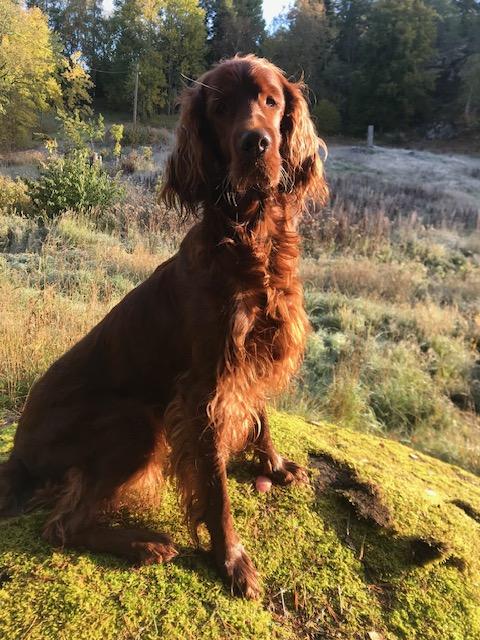
My Red Irish Setter rescue threw herself at everything. At me. At the floor. At life. She was joyful, enthusiastic, constantly moving, endlessly energetic. She seemed, to anyone who saw her, like a dog who was absolutely thriving.
And I remember the feeling of wanting to believe that. Of wanting the exuberance to mean what it looked like it meant.
But I had been doing this work long enough to notice something underneath it.
The excitement was real. But it was also — I came to understand — a way of managing something else.
Excitement as armour
There is a concept I come back to often when I think about Mojo in those early months.
Excitement as armour. Joy as a way of managing uncertainty.
A dog who is not yet sure whether this place is safe, not yet sure what the structure is, not yet sure who is handling what — that dog needs a strategy. And for some dogs, the strategy is to be very, very busy.
Being busy is a way of not having to feel the uncertainty underneath. Motion keeps the unsettled feeling at bay. Enthusiasm fills the space where ease hasn't arrived yet.
This is not unique to dogs. Humans do it too. The person who is always the most energetic in the room, always moving, always performing a kind of brightness — sometimes the energy is covering something quieter and less comfortable.
What excessive excitement can look like
There is a normal dog excitement — the burst of energy at a walk, the greeting at the door, the enthusiasm for play. These settle quickly. The dog goes in and out of that energy. They can come down from it.
The excitement I am describing is different.
It does not settle easily. The dog cannot seem to lower the energy even when everything is calm. There is something almost relentless about it — like the engine cannot switch off.
You might also see it combined with:
Jumping on people. Not just greeting — a sustained, repetitive jumping that doesn't reduce even when ignored.
Inability to rest. The dog who cannot seem to stop moving. Who settles for a moment and then starts again.
Panting when there is no physical reason for it. The body running warm even when the dog hasn't been exercised.
Constant seeking of attention or engagement. Not content to simply be. Always needing something to happen.
Individually, these things might just be a high-energy dog. Together, they can be something more — a dog whose engine is running too high because something inside is unresolved.
The day Mojo began to settle
I remember it clearly.
It was not a dramatic moment. There was no obvious turning point. It was just an afternoon where Mojo — for the first time — lay down somewhere other than at my feet, and genuinely rested. Not watchfully. Not with one eye open. Just rested.
I noticed it immediately because it was so different from everything that had come before.
And what had changed was not anything about Mojo. What had changed was the consistency of the communication in our home. The signals had become clearer. The structure had become more stable. And eventually, her nervous system believed it.
The excitement didn't disappear. Mojo is an Irish Setter — she will always have energy and joy. But it became lighter. Less driven. More genuinely hers and less of a strategy.
She stopped performing being fine. She started actually being fine.
What to watch for
If your rescue dog is very excited — constantly, relentlessly, in a way that doesn't settle — it is worth asking:
What is underneath this?
Is the excitement accompanied by any of the other signs I described? The inability to rest, the panting, the constant seeking?
Does your dog settle more genuinely in some situations than others — and if so, what is different about those situations?
Is the energy connected to your presence? Does it spike when you arrive and not quite come back down?
These are not diagnostic questions. They are observation questions. And observation is always the beginning.
Joy and ease are different things
A dog can be excited and not at ease. A dog can be enthusiastic and not rested. A dog can perform happiness while carrying something heavier underneath.
What I want for every rescue dog is not more excitement.
It is ease.
The kind of ease that shows up as a dog who rests genuinely, who can be still without anxiety, who greets you warmly and then settles. Who is present in the moment rather than managing it.
That ease comes when the communication is clear. When the structure makes sense. When the dog finally understands, at a level their body believes, that they can put the job down.
Find out more at healthedogs.net →
Celest · Heal the Dogs · healthedogs.net
