What happens after you open the door
You opened your home. You opened your heart. You drove to the shelter, or you filled in the forms, or you saw a photo online and knew immediately.
And you brought a dog home who needed somewhere to be. That is a generous thing to do. A loving thing.
And I want to talk about what happens next — because it often doesn't go the way people expect. And when it doesn't, the first place most owners look is inward. What did I do wrong? Why isn't this working? Is my dog okay?
This post is for those moments.
The picture you had
Before your rescue dog arrived, you had a picture.
Maybe it was a quiet dog curling up beside you in the evenings. A dog who would slowly come out of their shell, week by week, as they realised they were safe. A dog who would eventually look at you with the kind of trust that makes everything feel worth it.
That picture is not wrong. That moment often comes.
But between opening the door and arriving at that moment, there is usually a phase that the picture didn't include.
What the dog is actually doing in the first weeks
When a rescue dog enters your home, they are not settling. Not yet.
They are working.
They are gathering information — quietly, constantly, carefully. Who handles things here? Who communicates what to whom? Where do I fit in this structure? Is this safe?
Dogs understand the world through pack dynamics. And when a new dog enters a new pack, their first job — before anything else — is to understand how that pack works.
This is why many rescue dogs seem calm in the first weeks. Easy, even. Not because they are relaxed, but because they are in observation mode. They are being careful. They are taking stock.
I had a client once who said: "She was perfect for the first six weeks. We thought we'd got lucky." And then, slowly, things started to shift. The barking began. The nervousness around guests. The following.
She hadn't done anything wrong. Her dog had simply finished the observation phase and started operating based on what she had concluded: that no one was clearly handling things, and that she would need to do it herself.
The moment things change
This is what many rescue owners describe as the honeymoon period ending.
Around weeks six to twelve — sometimes earlier, sometimes later — behaviour shifts. The dog that seemed settled now seems unsettled. The dog that was quiet is now barking. The dog that was easy on the lead is now pulling.
And the owner thinks: what changed?
What changed is that your dog finished gathering information and made a decision.
They are not misbehaving. They are not ungrateful. They are not regressing. They are doing exactly what a dog does when they have spent weeks observing a situation and concluded that no one is clearly in the role of keeping things together.
They have stepped into that role themselves.
And carrying it — being responsible for every sound outside, every person at the door, every shift in the atmosphere — is exhausting for a dog. It shows up as vigilance, reactivity, anxiety, noise, restlessness. All the things we call difficult behaviour are the dog trying to do a job they were never meant to do.
The story we attach to
Here is something I see often, and I say it gently.
When we bring home a rescue dog, we often bring a story with us.
We don't always know what happened to this dog before they arrived. But we imagine it. We feel for it. We want to make up for it.
And that impulse — that tenderness — is one of the most beautiful things about people who choose to rescue.
But sometimes the story gets in the way.
When we feel sorry for a dog, we hold them differently. We give more reassurance. More attention. More eye contact. We tiptoe around them. We let things go that we would normally address, because we don't want to add to what they've already been through.
And in human relationships, all of that makes complete sense.
But in dog communication, it often lands differently than we intend.
A dog does not need your grief for their past. They cannot receive it in the way you mean it. What they receive instead is your uncertainty, your worry, your heightened attention — and they read that as information about the present situation.
They read it as: something is not quite settled here. I should stay on alert.
Mojo's story
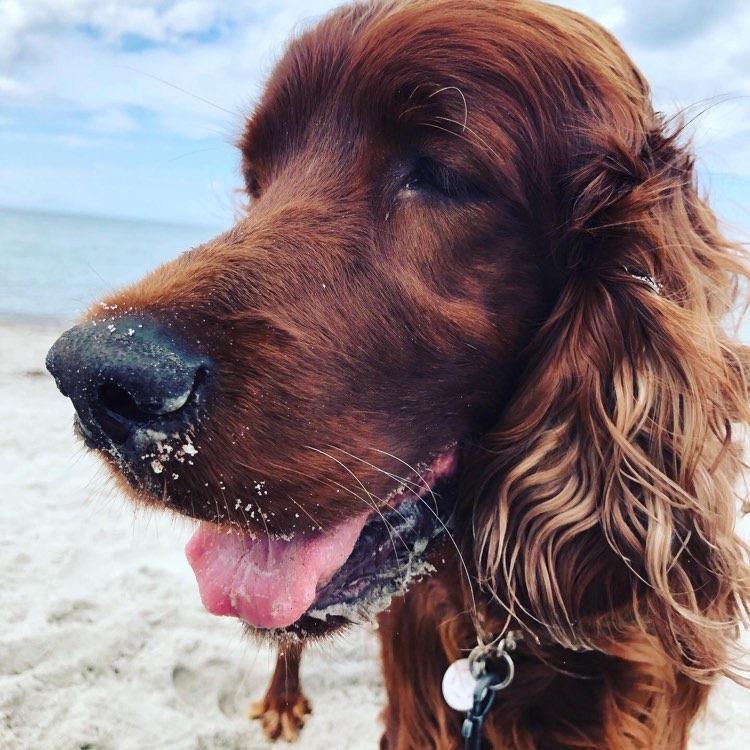
My Red Irish Setter rescue, Mojo, came to me with a lot of energy.
She threw herself at me. She was joyful, enthusiastic, constantly moving. And it would have been easy — very easy — to read that as happiness. As a dog who was thriving.
But I had learned enough by then to see something else underneath it.
Excitement as armour. Joy as a way of managing uncertainty.
Mojo was not relaxed. She was coping. She was performing a version of okayness that looked wonderful from the outside but was actually a strategy for navigating a situation she didn't yet feel safe in.
This is not rare in rescue dogs. Some shut down. Some become very still. And some become very, very busy — because being busy is a way of not having to feel the uncertainty underneath.
When Mojo finally began to settle — really settle, not perform settling — it looked quieter. Less dramatic. She rested more. She followed me less. She stopped working so hard to be fine.
That quietness was the real joy. Not the performance of it.
Moni's story
My Portuguese rescue Moni arrived differently.
She was more watchful. More careful. She took longer to trust, longer to lower her guard, longer to decide that this home was something she could actually rest in.
And I had to resist the urge to rush that. To reassure her more. To pull her toward connection before she was ready.
What Moni needed was not more of me. She needed me to be steady and consistent so that she could gather the information she needed at her own pace. She needed to see, over time, that the atmosphere in our home was the same today as it was yesterday. That nothing unpredictable was going to happen. That I had things handled.
When she finally curled up and exhaled — not alert, not watchful, genuinely resting — that was the moment. Not because I had done something dramatic, but because I had done the same quiet things, consistently, until her nervous system believed it.
What your rescue dog is looking for
Every rescue dog — regardless of their past, regardless of their personality, regardless of whether they came from a loving home or a difficult one — is looking for the same thing when they arrive in your house.
They are looking for someone who has things handled.
Not someone who is perfect. Not someone who never feels anything. Not someone who has read every book and done every course.
Someone who communicates — in the language dogs actually understand — that this is a safe place. That the structure here is clear. That they don't have to take the responsibility for everything.
Dogs are extraordinarily adaptable. They can cope in many, many situations. But if you want more than coping — if you want real trust, real rest, real connection — then it becomes your job to meet your dog in their own language.
To see the human world through your dog's eyes.
To understand what they are actually asking, rather than what you are imagining they need.
The one thing that helps most
Before anything else — before any technique, any training, any course — there is one thing that helps more than all of it.
Seeing your dog clearly.
Not the dog from the story you brought home with you. Not the dog you feel sorry for. Not the dog you imagine they were before they arrived.
The dog in front of you today. The dog who is communicating, constantly, about what they need.
When you start to see that dog — really see them — everything else becomes possible.
Listen to the podcast episode
This post is the companion to Episode 2 of Heal the Dogs with Celest — The Rescue Dog.
In the episode I talk about Mojo, about the intel-gathering phase, about what a dog is actually doing in those first weeks — and what shifts when you stop seeing a dog that needs saving and start seeing a dog that needs guidance.
Find the podcast wherever you listen.
There is more coming
This is the first in a series of posts about rescue dogs — covering everything from why they follow you everywhere, to why they won't eat, to what trust actually looks like in a dog who is learning to feel safe.
If you have a rescue dog at home, or you are thinking about bringing one home, come back here. There will be more.
And if you want to go deeper now — my work is about helping dog owners understand what their dog is actually communicating, so both of you can stop carrying what was never yours to carry.
